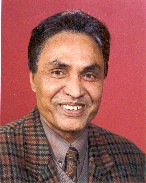
Mohammed Nesar Ahmed Kaiser (born 31 July 1951) is a politician (Socialist) and a public speaker having a strong interest in critical global issues.
Born and brought up in Sylhet, Bangladesh (Present location: Espoo, Finland). Since childhood, Mohammed Kaiser has been fascinated by the constantly changing world and understood that the reason for the inhumane living condition of poor masses is man-created exploitation. Being a meritorious student, Kaiser was always quick in finishing School/college related tasks and then he continued to read books, study ideas and compose the poem. Later he joined a communist party which enriched him in understanding the root cause of poverty and oppression. By the age of 17, he joined student movement against the Pakistani military dictatorship and led the student movement in various capacities (1967-1970) with fearless determination. He was arrested and injured by the then Pakistani military regime. After being released on bail he turned into a symbol of absolutism and became a dedicated revolutionary.
As an efficient organizer, Kaiser was always busy in advancing the movements for independence of Bangladesh at the one hand and as a communist, his prime goal remained to free the poor masses from the cruelty of capitalism at the other. Whilst struggling to achieve a new and better order of society, he learned the writing of Karl Marx and Friedrich Engels along with V. I. Lenin, Josef Stalin’, Leo Trotsky, Chairman Mao, Hu Chi Min, Fidel Castro, Ernesto Che Guevara, October revolution, French revolution, Chinese revolution and many other revolutionary backgrounds including the achievement of Cuba. He did not forget to compose the poem and participate in socio-cultural activities while even running out of time. He obtained first prize in the self-composed poem in the Sylhet Government M. C. College’s annual literacy function in 1969.
The ruling people in newly independent Bangladesh, as of their class interest, deliberately had forgotten promises those were given to people before the liberation war. Particularly they became repressive to the revolutionary left and failed to satisfy the masses. In 1975, a brutal gang of army officers under the shadow of reactionary forces having impetus from the USA staged a coup and killed top leaders of the dominant party, the Awami League, along with their family members including the founding father and president of the nation, Sheik Mujibur Rahman.
Killers motivation seemed were changed the wheel of power and implement the strategy of Pakistan branded political Islam. They tried to erase the pro-liberation forces and to this end, they even killed most of the army officers and soldiers those who fought in the war of independence whether by staging fake trials such as the killing of freedom fighter officer, Colonel Abu Taher or on direct shooting inside the garrisons.
Post-1975 ruling gangs, who occupied state power whether army-based or army-backed civilians dolls, were committed to using “Islamic Card” very openly. And of course, Uncle Sam, the USA assisted them in all wrongdoings. The Wahhabi doctrine of extreme Islamism was exported from Saudi Arabia and from other Gulf Kingdoms directly or via Ruling Generals of Pakistan. They rewrote the constitution and cut off four state principles; nationalism, democracy, socialism, and secularism. One of the military-autocrats, General H.M. Ershad, even changed the country’s recognized logo from “Peoples Republic of Bangladesh” to “Islamic Republic of Bangladesh.” All these post- 75 regimes happily implemented all sorts of repressive policies of neoliberalism including the notorious austerity and Structural Adjustment Plan (SAP). These generals tried hard to strip the benefits of Independence from people altogether. They tried to eradicate democracy and notably left politics from the country.
In avoiding the risk of persecution he took the job of teachership in Sylhet and later he had given thought that he was not meant to be a government worker. He joined Worker’s Party of Bangladesh which was seemingly committed to establishing communism. As a full-timer in the party, he was positioned as the Member to the Central Committee and as the Secretary Sylhet District Committee, where he was one of the leading in-charged to organize peasants and workers movements at the grass root.
To get rid of the chain of autocracy, Workers Party in alliance with other political parties launched a movement against the army dictatorship in order to restore democracy and self-determination of people. As an uncompromising leader, and for his vocal attitude and fearless activities, politically motivated criminal cases were set against him by General Ershad regime. He was arrested by the repressive Ershad regime again in 1987 and was locked inside the prison cell under inhuman condition. He developed severe Hepatitis B in 1984 and continued recurrently. In the prison cell, his health condition deteriorated badly. Witnesses were occasionally scared for his life. Due to a tremendous movement demanding his release outside and Amnesty International’s strong appeal, he was released on bail by the end of 1988. By December 1989, his survival had become extremely critical. In such a horrible situation, the doctor recommended him to leave Bangladesh promptly and move to a cold weathered country.
Formalities for travel were met quickly, and Kaiser reached Finland on 5 January 1990 in a weather of the minus 14 degrees. After some days in the new environment, he appeared to a doctor at a local hospital. Medicines were applied, and he had been gaining health gradually. It took 5 / 6 months in totality to get cured of Hepatitis B. Well availability of books in Finnish public libraries had facilitated him very much and he continued independent study on international politics. Later he got admitted to the University of Tampere, Finland, in the department of international relations. Title of his Bachelor thesis; “Dust of the Cold War” Title of Master thesis; America and the New Era’s World Order”; An analysis of the post- Cold War World Order from Neorealist Perspective, IR-European Studies, University of Tampere 1998. While in service to the city of Espoo, he did obtain some postmaster study credits from the University of GÅVLE, Sweden and at the University of Helsinki. These extra credits (along with some credits obtained on correspondence courses) he has been awarded Ph. D. in Political Science. Title of the Doctoral thesis; “Democracy, Islam and the Problems of Today’s World: Contemporary Political Ideas in Muslim Societies” 2009.
In 1999-2011, he worked in various capacities such as; job planning officer, social officer, job coach, counseling specialist, and project coordinator to the city of Espoo, and in the Settlementti Louhela, Järvenpää, Finland. He was elected with the ticket of Finnish Left Alliance as a councilor to the city of Espoo in 1999 and retained the position until 2008 (last three years returned from the position of a substitute). His experience of public life activities are huge. Since 2016 he serves as a Deputy of the National Advisory Board for Ethnic Relations and before this he has served as a member ( 2014-16), Working Group to European Politics, Ministry of Justice, Finland. As a member he served also in the advisory board on multicultural affairs, the board of socials and health affairs, the board of youth affairs, the board of Finnish linguistic education affairs, Equality Commission for the city of Espoo and Deputy Leader 11, Left Alliance councilor group for four years. Prior to these, he worked as a member to the Relief and Rehabilitation Committee: Golapgonj sub-district (1971-72) and member of National Rescue Team at the time of natural calamities such as Flood-Cyclone etc. (1969-1989) in Bangladesh. He was a committed organizer to the movement for the independence of Bangladesh and a veteran of anti-autocratic movement (Ershad fall movement) in Bangladesh.
Mohammed Kaiser wrote well above 200 articles in various Newspapers and Periodicals on contemporary issues of public interest and issues related to cultural diversity, & social inclusion in Bangla, English, and Finnish. He has written a book in Bengali, SHUSHASONER ETHIKOTHA (In English; History of Good Governance), Published by Razwan Ahmed, Print Garden Press, Sylhet, Bangladesh, 2008. From 2016, he is working for writing a book in English in the name and style, “The Violent Empire We’ re In” which is scheduled to be published by December 2018.
Kaiser visited well above 70 countries and has attended countless International Seminar and Conferences. As a facilitator, he presented a discussion paper along with a teaching module at the workshop in Burgas, Bulgaria, to the EU based project, the “Uniting Humanity”- Learning Advocacy in World Citizenship ( a facilitator development programme on development education and global issues). The “Scarman” Trust from London has coordinated the project where other partners were; University of Gåvle ( department of education ) Sweden, Kingston University (department of education ) -UK, Leeds Metropolitan University- UK, Open Education Centre (Bulgaria), CEWE, CHWEA, and FAHAMO . Conference on the European Union of Supported Employment in Helsinki. Conference on Diversity Management of the Transnational NET-WORK-IN Partnership, in Venice- Italy, Antwerp-Belgium, Helsinki-Finland, Arhuus- Denmark, and in Eindhoven in the Netherlands. European Council on Refugee and Exile, ECRE-EU, Tampere Summit- Parallel meeting, Finland. Flood Action Plan and Food Security in Bangladesh, Venue: European Parliament, Brussels, Belgium, 1996, and Problem of Non-resident in Building of National Economy in Bangladesh, Bedford, UK, 1982.
Family:
Wife: Lipa Kaiser
Children: Likhon Rabi Kaiser, Jonaki Dipta Kaiser, Milki Mardeka Kaiser, Ripon Rafi Kaiser, Shaki Fahmida Kaiser, and Milon Kabir Kaiser.

 Slaughterous Empire